Everyone in the world has to take a private vote by pressing a red or blue button. If more than 50% of people press the blue button, everyone survives. If less than 50% of people press the blue button, only people who pressed the red button survive. Which button would you press?
Like all good internet dilemmas, it’s an obviously non-obvious problem. The less one thinks about it the sooner one arrives at an answer and the harder it is to talk one out of it. Logical people find no logical argument against red; moral people find no moral argument against blue. In the end it’s really not clear the way things would go.
The first error everyone makes is in thinking that there is only one right answer to the dilemma. That is misidentifying the kind of dilemma this is. There are three outcomes: either you are saved, you save yourself or you die. So really, there are two equilibria, collaborative risk or individual salvation. We are not in a prisoner’s dilemma1 as there is no Faustian bargain: what we are looking at is a coordination game2. There is no us or them, we can all try to save everyone or we can all save ourselves. The more we agree the fewer die.
No lesser of an error is assuming that we all have a common goal or even the same interpretations of common goals we may coincide on. The most common goal is to maximize the survivors or to minimize the casualties, the two being sides of the same coin. Directly opposing it is the also-popular argument for dying. Both arguments hold that some deaths are justified, either those of others or their own: “some will inevitably die” and “I don’t want to live in a cruel world,” respectively. It’s one’s desire to help against one’s survival sense wrapped up in whatever framework we may subscribe to.
To objectively approach something resembling an answer we have to level and examine the playing field. After ruling out the colorblind, slips, mistakes, communication, coercion and similar exits it is now possible to look at cases for both choices.
Game theory is a good place to start as it is simple and visual. For this dilemma we have two options and two scenarios which gives us four outcomes of which two are equal, so three outcomes in the end:
One can either choose to trust that they will be saved knowing they could be killed or decide to guarantee their own survival. While any one person’s blue press is insignificant, a red press is exclusively for the presser3. This choice only accounts for rational outcomes. Someone who values the choice over the outcome will press blue regardless, but this is a rare minority.
Philosophy can offer some insight as to the morality, though not all frameworks are useful. Being a coordination game, Kant’s imperative4 instantly renders this dilemma moot (even in a red world there are no blue-pressers to die). The hinge is placed on where we believe we lie, what we think others will press. If we simply assume that blue is twice as likely because half as much agreement is needed, we are confusing the threshold with the odds of clearing it. It may be that they’re equally impossible but that one is a much narrower miss or that one is disproportionately more likely for reasons that are not immediately obvious.
Turning back to the post, there is a part that I omitted from the beginning and that was the attached poll:
Tim's poll, final results:
Netizens5 generally trend blue, narrowly blue, as in the above poll from the original tweet. Note that unlike the dilemma, people are able to see prior votes (even if only by cheating) and definitely were able to discuss, extensively. This is one of the places I observed the rationalizations above6. Along with everyone’s takes there were many memes fueling the controversy, for example this midwit meme7:
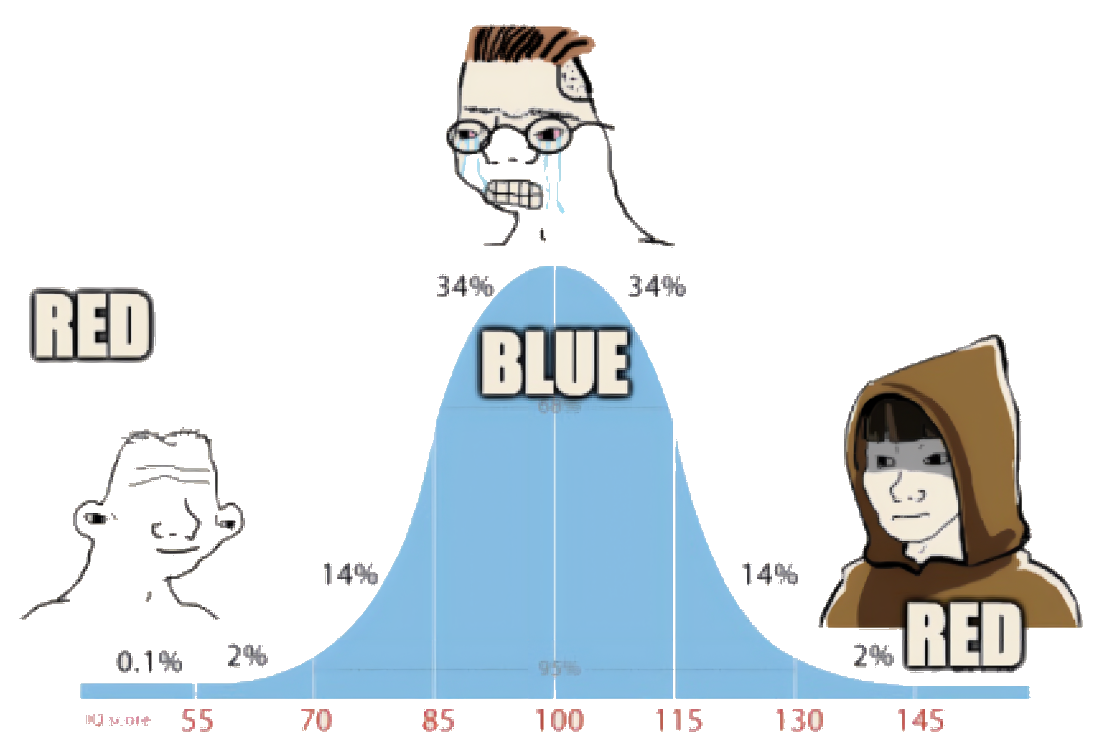
Just like the arguments in text, even the memes had chirality. The meme explicitly arguing blue to be the midwit choice implicitly argues it to also be the majority choice, and therefore the better option. Inviting the meta-midwit meme:
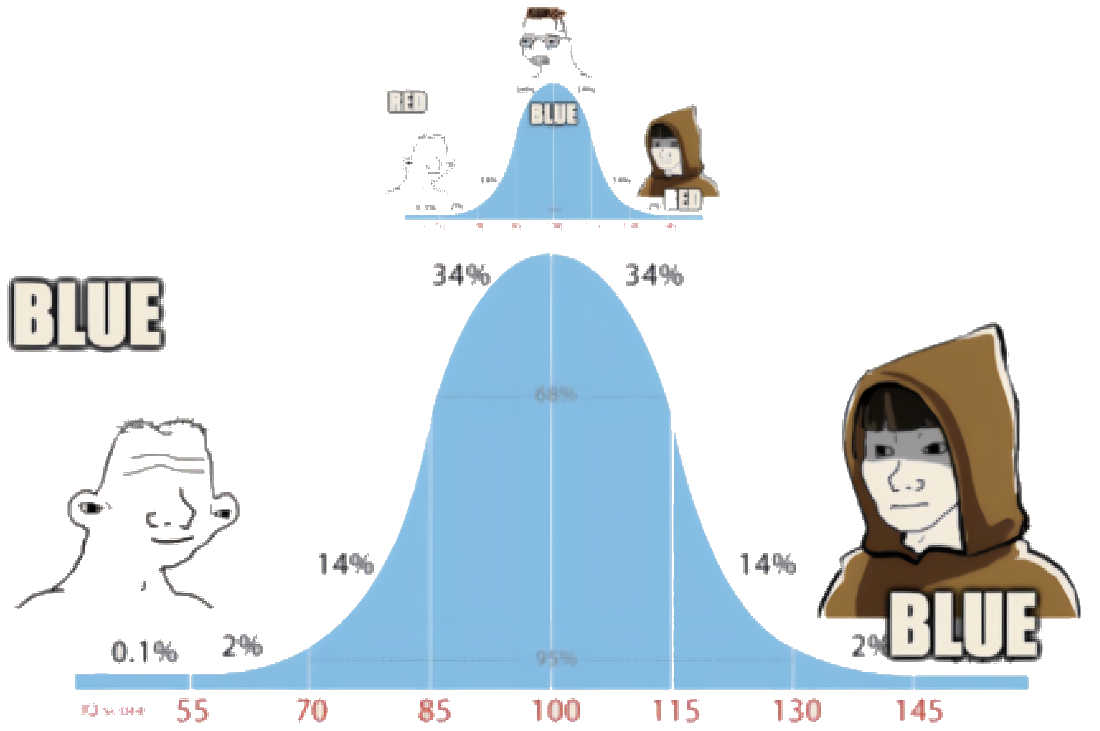
The nature of the problem and this unstable rhetoric along with the narrow wins across polls made me question what we would truly trend to and only made me doubt the polls more. This brought me to the idea of estimating the outcome from data or analogs to the data.
To simulate, the first step is to establish the variables at play, being trust and altruism in this case. Respectively, how much you believe in others and how much you value them. As stated previously, if altruism alone is taken into account the choice is immediately blue.
Altruism is difficult to estimate. For a lower bound I looked at organ donation rates which range from fractions of a percent for essential organs to a few percentage points for things such as blood. For the upper bound I looked at dictator game meta-studies from where I got the generous bound8 of 28%9.
Trust is the key variable of the two. It varies wildly between nations and is the main driver of choice. My primary source is the World Values Survey10 data corroborated with results from behavioral trust games11. The values for trust range from a low of 5% in Colombia to a high of around 74% in Denmark with the majority of countries sitting on the lower half of the distribution.
To simulate this I ran ~7.0B agents per run based on population data matched to the countries for which trust data was available plus an estimate12. These ranged from 5.1 million agents to simulate New Zealand to over 1.4 billion agents to simulate China13.
Each agent is given a randomized trust and altruism sampled from their respective nation’s ranges and is given the following rule:
Press blue if \( \text{trust} \times (1 + \text{altruism}) \ge 1 \).
Once every country was run their results were merged to form the world outcome that is closest to the real population and estimated behavior giving us blue presser/death toll numbers. Per one hundred thousand people:
🇺🇸 USA · ~2,000 die
🌍 World · ~5,000 die
🇸🇪 Sweden · ~21,000 die
🇩🇰 Denmark · ~42,000 die
Nearly half of the surveyed countries are below the US for trust, and almost all of their presser counts are a rounding error14. In every simulation I could run, the most trusting nations were also the most devastated.
Without clearing the bar, the closer a country is to blue winning, the worse it gets. Small but high-trust countries can stand to lose nearly half their population while large low-trust countries that would dwarf them in any other category lose but a fraction of theirs. There are, of course, outliers. If we are to take the trust data at face value, China sits at the intersection of population and trust that would place its deaths north of 300 million, the bulk of the global toll: that world figure leans on China’s contested 64%, and without it the world’s death rate would sit below the US’s. Conversely, the least trusting nation in the sample, Colombia, is also quite small and would stand to lose under 2 thousand people out of the whole nation.
Half-coordinated optimism kills far more people than selfishness ever could15. Getting half of earth on board is not more likely than getting most people to save themselves, but the thought that it may be could doom nearly half the people of certain nations.
In the dilemma where nobody can communicate, if you’re undecided press red. There’s no guarantee otherwise. But in our world, where communication does very much happen, blue is the right choice (as we saw in the poll).
-
A prisoner's dilemma has a single dominant move, defect, no matter what the other player does, and its one equilibrium is bad for everyone. This is not that: pressing red keeps you alive whether blue wins or loses, so red is merely the safe play, and the only pull toward blue is the value you place on others. SEP, "Prisoner's Dilemma". ↩
-
A coordination game: the two outcomes that save everyone, all-red and all-blue, are equally good, but pressing red keeps you alive either way, so landing on the all-blue one takes trust rather than logic. SEP, "Game Theory". ↩
-
Survivor guilt, the weight of having lived where others did not, was a listed feature of post-traumatic stress in the 1980 DSM-III and dropped from the criteria by 1987. on its diagnostic history. ↩
-
Kant's Formula of Universal Law, from the 1785 Groundwork: act only on a maxim you could at the same time will to be a universal law. A world where everyone presses red, or everyone presses blue, leaves no one to die; the deaths come only from a split world, which no shared maxim produces, so the rule is neutral between the two safe options. SEP, "Kant's Moral Philosophy". ↩
-
A netizen is a citizen of the internet. ↩
-
Cleaned up from the comment sections, with the profanity and the typos taken out and the reasoning left in. ↩
-
The bell-curve meme: the low end and the high end land on the simple answer while the middle overthinks its way somewhere else. Know Your Meme. ↩
-
The high end on purpose, to give blue the best chance. ↩
-
Engel's meta-study of dictator games (129 papers, 41,433 observations) puts average giving at 28% of the pot. Engel, 2011. The mean flatters: a third of dictators give nothing. Costly altruism toward strangers runs far lower; non-directed kidney donors, who give a kidney to someone they will never meet, numbered 387 in the entire United States in 2019. OPTN data, Jan et al. 2022. ↩
-
World Values Survey, Wave 7 (2017-2022), Question Q57: "Generally speaking, would you say that most people can be trusted or that you need to be very careful in dealing with people?" worldvaluessurvey.org. Denmark itself is not in Wave 7; its figure comes from the European Values Study 2017, merged into the same series. ↩
-
The corroboration, three different instruments: the Integrated Values Surveys put Denmark at 73.9% (2022, via Our World in Data); the OECD's 2023 Trust Survey at 75%; and a rescaled European Social Survey reading at 77.3% (2018). Behaviorally, in the trust game (the money you hand over is multiplied before the other player decides what to return) senders part with about half across 162 studies. Johnson & Mislin, 2011. ↩
-
Trust and altruism are drawn from Beta distributions around each nation's mean (concentration 7); an agent presses blue when trust × (1 + altruism) ≥ 1, the risk-neutral expected-value rule at altruism a = 0.28. Blue wins only if more than half of everyone presses it, and across every country and the world it never did. The death rate is a closed-form result, confirmed by a Monte-Carlo run at the real population, about 7 billion agents. Code and parameters are in the repository above. ↩
-
This could have been done with a normalized hundred thousand per country, or estimated as an integral, but what's the fun in that? ↩
-
Under the model's preset conditions: no errors, no communication, and no coercion. ↩
-
That is, if you don't argue that the failure is the fault of the majority, and thus always a problem with selfishness. ↩