bqn-brane-of-life
N-dimensional Game of Life in BQN, playable in any dimension and viewable as a 1D-to-4D slice of it.
| Stars | Language | Updated |
|---|---|---|
| 0 | BQN | 2026-10-09 |
- Topics: 4d, array-programming, bqn, cellular-automata, conways-game-of-life, game-of-life, generative-art
An n-dimensional Game of Life engine in BQN. It runs Conway-style rules in 3D, 4D, or higher, and renders a lower-dimensional slice of the grid as an animated loop. The default view is a 3D volume sliced from a 4D automaton.
Built to explore how Game of Life behaves above two dimensions. There is no application beyond that.
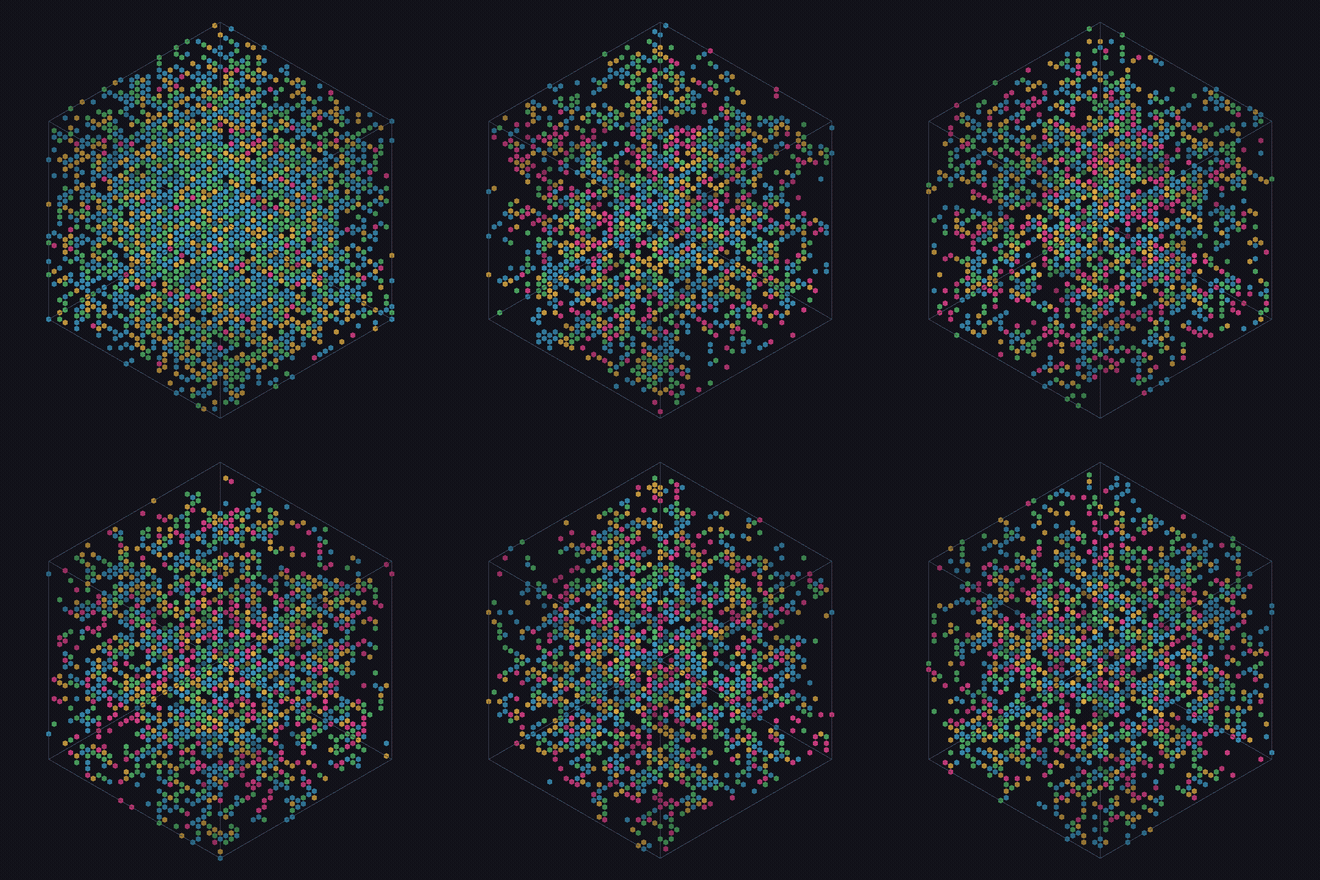
3D slice of a 4D S4/B4 automaton. 32³ voxels over 96 generations, coloured by
each cell's dominant neighbour axis.
Overview
Ordinary Game of Life is two-dimensional: a cell lives or dies according to its 8
neighbours. This generalises to any dimension d. A cell has 3^d − 1 neighbours, and a
rule is a set of neighbour counts for survival and for birth.
The engine runs that in arbitrary d, then renders a k-dimensional slice
(k ≤ d) so the result can be displayed.
Because the renderer shows only k of the d axes, the neighbours along the
hidden axes never appear on screen. The fraction of each cell's neighbourhood
that is off-screen is:
invisible = (3^d − 3^k) / (3^d − 1)For the default 3D view of a 4D grid that is (81 − 27) / (81 − 1), or 67.5%.
Cells then appear and disappear with no visible cause.
| d | Moore neighbours | invisible for a 3D slice |
|---|---|---|
| 3 | 26 | 0% (nothing hidden) |
| 4 | 80 | 67.5% |
| 5 | 242 | 89.3% |
Requirements
- CBQN, with
bqnon your PATH ffmpeg, to assemble frames into video and gif
There are no other dependencies. The renderer is pure BQN and writes PPM frames; ffmpeg is only used to stitch them into a loop.
Usage
make test     # engine correctness gate (Conway patterns at d=2, rank checks at d=3/4)
make hero     # render the default loop to assets/hero.gif and out/brane.mp4
make search   # search for viable 4D rules and write rules.md
make clean
Or run the engine directly:
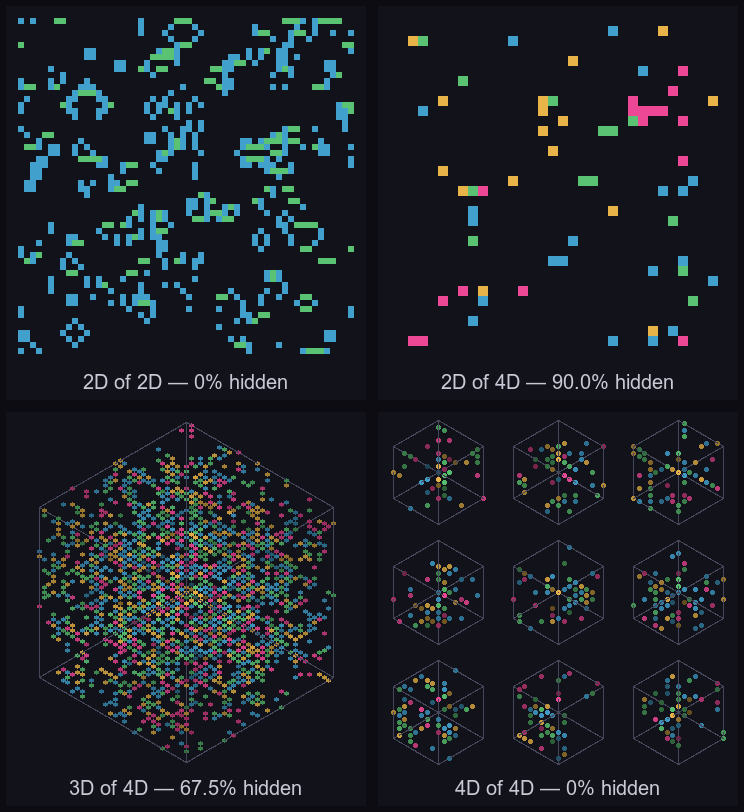
bqn brane.bqn k=3 d=4 n=32 rule=S4/B4 steps=200The invisible fraction is printed on each run. Some combinations:
bqn brane.bqn k=2 d=2       # ordinary flat Life         (0% hidden)
bqn brane.bqn k=2 d=4       # a 2D window on a 4D grid    (90.0% hidden)
bqn brane.bqn k=3 d=4       # the default cube            (67.5% hidden)
bqn brane.bqn k=4 d=4 n=10  # 4D as a grid of cubes       (0% hidden)
bqn brane.bqn k=1 d=3       # a single line               (92.3% hidden)
Render modes
The renderer chooses a mode from k, the visible dimension (1 ≤ k ≤ 4):
| k | mode |
|---|---|
| 1 | a line of cells |
| 2 | a flat grid (ordinary Game of Life) |
| 3 | an isometric voxel cube |
| 4 | a grid of cubes, one per position along the 4th visible axis |
Each cell is coloured by the axis most of its neighbours lie on. In a 4D run the hidden axis is drawn in magenta, so you can see which cells are driven from off-screen.
Configuration
Options are passed as key=value arguments to brane.bqn:
| option | default | meaning |
|---|---|---|
k |
3 |
visible dimension, 1 to 4 |
d |
4 |
automaton dimension, at least k |
n |
32 |
grid side length |
rule |
S4/B4 |
survive/birth rule (see below) |
steps |
240 |
generations to render |
seed |
42 |
RNG seed |
px |
800 |
canvas size in pixels |
wc, wh |
1, 1 |
centre and half-width of the hidden-layer seed band |
out |
frames |
output directory for PPM frames |
The makefile exposes the same settings as uppercase variables, e.g.
make hero K=4 D=4 N=10.
Rules
Rules use Carter Bays' survive/birth notation, with ranges allowed: S4/B4,
S3-6/B3, S5-8/B9-10. S lists the neighbour counts at which a live cell
survives, B the counts at which a dead cell is born.
Conway's S2-3/B3 does not survive in 4D. With 80 neighbours instead of 8, a
random field overcrowds and dies within a few generations. search.bqn scores
random interval rules on a shared seed for survival, low density, and sustained
change. It writes a ranked table to rules.md. The default S4/B4
comes from that search. It holds a steady density near 8% with high turnover, so
the volume stays translucent and does not strobe.
How it works
A neighbour count is the grid summed over every shift. In an array language that is the same code at any rank. The sum is separable: one 3-wide sum along each axis, composed over all axes. So 4D costs about 12 shift-and-add passes rather than the 81 needed to build every shifted copy.
Face ← {v←𝕨=↕=𝕩 ⋄ (v⌽𝕩)+(-v)⌽𝕩}   # the ±1 toroidal shifts along axis 𝕨, summed
Sum3 ← {𝕩+𝕨 Face 𝕩}               # 3-wide sum along axis 𝕨
Box  ← {𝕩 Sum3´ ↕=𝕩}              # box sum = Sum3 folded over every axis
Neigh ← Box-⊢                     # neighbour count = box minus the centre
Life ← {s‿b←𝕨 ⋄ n←Neigh 𝕩 ⋄ (n∊b)∨𝕩∧n∊s}   # 𝕨 = ⟨survive, birth⟩
Boundaries wrap on every axis, including the hidden ones. Dimension is read from
the grid's rank, so d is a parameter rather than a rewrite. Correctness is
pinned at d=2 against known Conway patterns before anything runs in 4D; see
test/test_life.bqn.
Project structure
| file | role |
|---|---|
life.bqn |
dimension-agnostic engine (Box, Neigh, Life, Run, Trajectory, AxisDom) |
seed.bqn |
initial conditions (Noise, hidden-layer Slab) |
search.bqn |
rule search, writes rules.md |
render.bqn |
k-D brane to RGB raster (line, grid, cube, or small multiples) |
ppm.bqn |
PPM (P6) writer |
brane.bqn |
entry point: evolve, slice, render frames |
test/ |
correctness gate |
plan.md, SPEC.md |
build plan and original brief |
References
- Carter Bays, on higher-dimensional Life rules and survive/birth notation.
dlozeve/bqn-graphics, a BQN array-to-PNM reference. This project emits PPM directly instead.- BQN and CBQN. Media-pipeline conventions follow BQNoise.